Drifting Paths
There's a particular feeling that only shows up after you've gone far enough away from yourself to come back. You return to a road you used to know and something about it has shifted — not the road, you. The buildings haven't moved. The trees are the same trees. But the version of you that used to walk this road isn't the one walking it now, and the dissonance between them is what the whole song is trying to name.
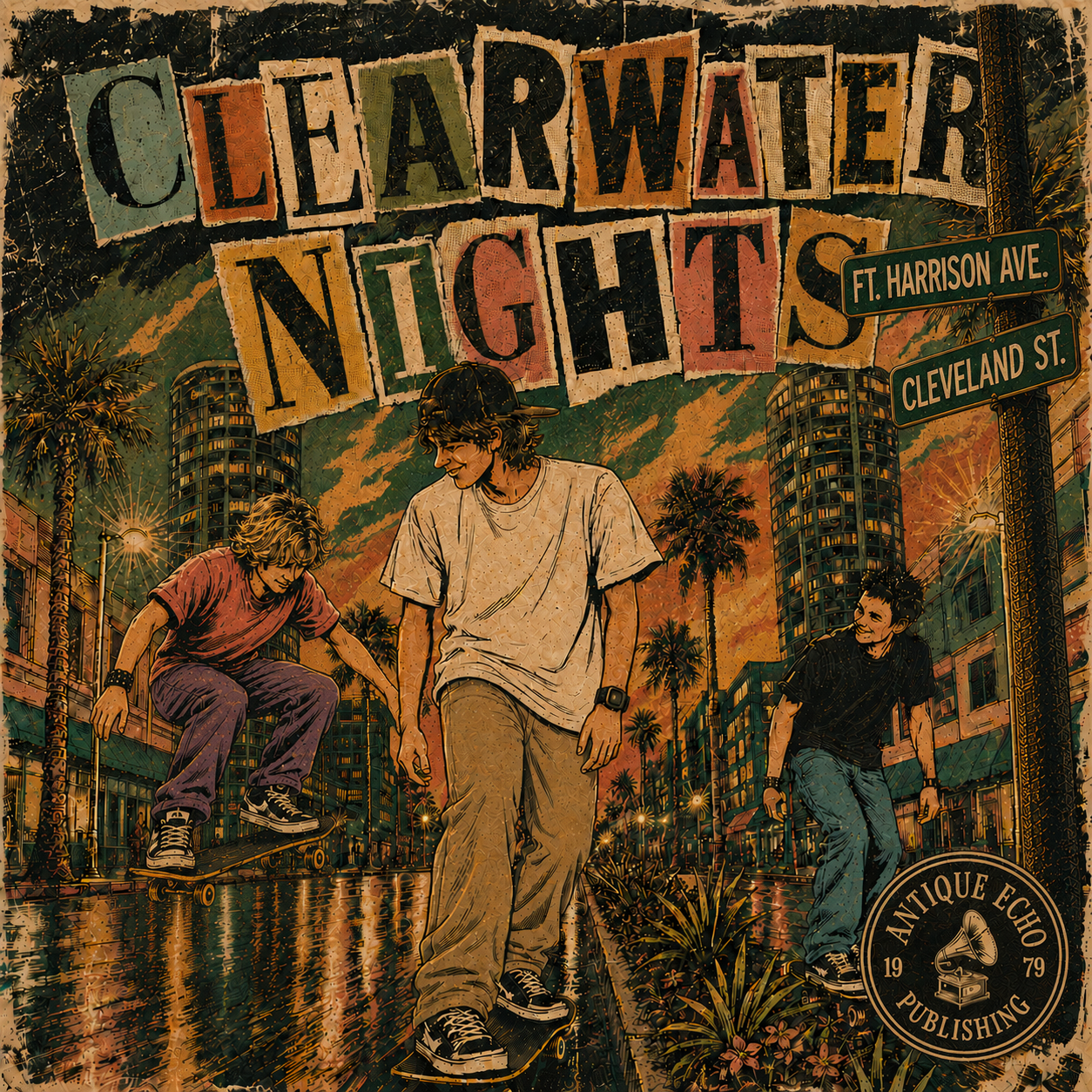
Drifting Paths opens Clearwater Nights because it's the song closest to the question the rest of the album keeps circling back to: what do we owe the versions of ourselves we no longer are, and what do we let go of so the next one can show up?
I wrote it as a duet on purpose. Two voices, because that's how it actually feels. There's the voice that's walking through the dark — the one with rain on the boots, the one staring at himself in shattered glass and recognizing a ghost. And there's the other voice, the one that's already on the other side, ghostlike and steady, telling him to keep walking. They aren't strangers. They're the same person at different points along the same road. The song is what happens when those two voices finally meet each other in the open.
The imagery came first, before I knew what the song was. Old motel signs. Telephone wires holding cold rain. Hollow towns with broken bulbs. Pines moving in a wind you can't see the source of. These weren't metaphors I was reaching for — they were the actual visual texture of a particular kind of night I've lived through more than once. The kind where you don't really know where you're going, only that you can't stay where you are. Where the road keeps stretching out in front of you and you keep moving down it because moving feels safer than stopping.
What I didn't know when I started writing was that the song wasn't going to stay in the dark. There's a turn about halfway through, a quiet break where everything almost collapses to nothing — a single distant note hanging in empty space — and then the song lifts. The two voices come together for the first time. "Every dark road opening wide again, like the night itself finally let us in." It's not triumph, exactly. It's more like recognition. The dark didn't kill you. It made room.
The line that landed first for me, the one the whole song probably grew out of, is this:
Every broken map I leave behind Makes room for what I've never defined.
That's the thing I keep coming back to. Every old version of who I thought I was — every map of a self that turned out not to lead where it said it would — leaving those behind isn't loss. It's clearing space. The shape I became isn't a shape I drew up in advance. It's what was waiting on the other side of the road I had to walk to get rid of the old maps.
The duet structure ends up being important here too. By the final chorus, the two voices aren't alternating anymore. They're singing together, harmonizing through the same lines. "I'm finding myself again, past the fear and the rusted ends." Whatever those two voices were before — past self and future self, scared and steady, lost and found — they're the same voice now. They had to walk through the same storm to figure out they always were.
I produced this song with a lot of space in it. Storm ambience, pedal steel cries between phrases, pines you can almost hear in the silences. That's deliberate. Drifting Paths is supposed to feel like a real night — the kind you remember years later not because anything dramatic happened but because something in you shifted while it was happening. The atmosphere is the song. Strip it away and the lyrics are just words. With it, the words become a place you can stand in.
If you've ever stood somewhere familiar and felt like a stranger — at a hometown bar that doesn't recognize you anymore, on a road you drove a hundred times that suddenly feels rearranged, in a relationship you outgrew before you knew you were growing — this song is for you. It's the soundtrack to the version of you that walked through the dark and came out the other side knowing something it couldn't have known any other way.
The closing line of the song is "And I finally know the soul I'm standing in." That's the whole album in one line. Clearwater Nights is about the moments that taught me who I was, but most of them only made sense long after they happened. Drifting Paths is the song that lets me sit inside that recognition. That after all the broken maps and shifting shadows and ghosts in shattered glass, you eventually get to a place where the road opens up and the morning light hits and you finally know — really know — the soul you've been carrying all along.
That's the song.
—