By Jason Wydro — W3 Developing, LLC Published July 2026. All legal and technical claims are accurate as of the publication date; the laws and products described here change quickly, and dates are given throughout so you can check what has moved since.
I have built websites for a living since 1999. That means I have spent more than a quarter of a century on the inside of the machine most people only experience from the outside — the analytics scripts, the tracking pixels, the ad platforms, the "measurement" tools that clients ask for and vendors push. I know exactly what a modern web page can see, because I am one of the people who wires it up.
So believe me when I tell you this: the feeling you have — the feeling that everything you type, tap, say, and send is being read by something — is not paranoia. It is an accurate description of the default settings of modern life. I call it the : the constant, automated, mostly invisible harvesting of your communications and behavior, not by a person hunched over your messages, but by systems built to turn your life into a profile and your profile into money — or, increasingly, into evidence.
This article is about the opposite of that. It is about TRUE privacy — what the phrase actually means once you strip away the marketing, how to achieve it in your everyday communication with friends and family, and, just as importantly, how to talk your friends and family into it without sounding like you've wrapped your router in tinfoil. That last part matters more than any app recommendation, because private communication has a property that almost nothing else in technology has: you cannot do it alone. A private message needs a private recipient. Privacy is a team sport, and your team is your family group chat.
Every technical term in this article is defined in plain language in the glossary at the end — including the terms used inside the definitions, so nothing is left unexplained. Every factual claim is sourced, and the sources are listed at the bottom.
Part One: What "TRUE Privacy" Actually Means
Privacy is not secrecy
Start with the distinction that dissolves the most common objection you will hear ("I have nothing to hide").
Secrecy is hiding what you do. Privacy is controlling who gets to watch. You close the bathroom door not because what happens in there is a scandal, but because it is nobody's business. You seal a letter in an envelope not because the contents are criminal, but because the mail carrier's job is to deliver it, not to read it. Everyone — including the person who says they have nothing to hide — locks doors, wears clothes, and lowers their voice in restaurants. Everyone already practices privacy. The only question is whether the digital rooms of your life have doors at all.
Here is the working definition this article uses:
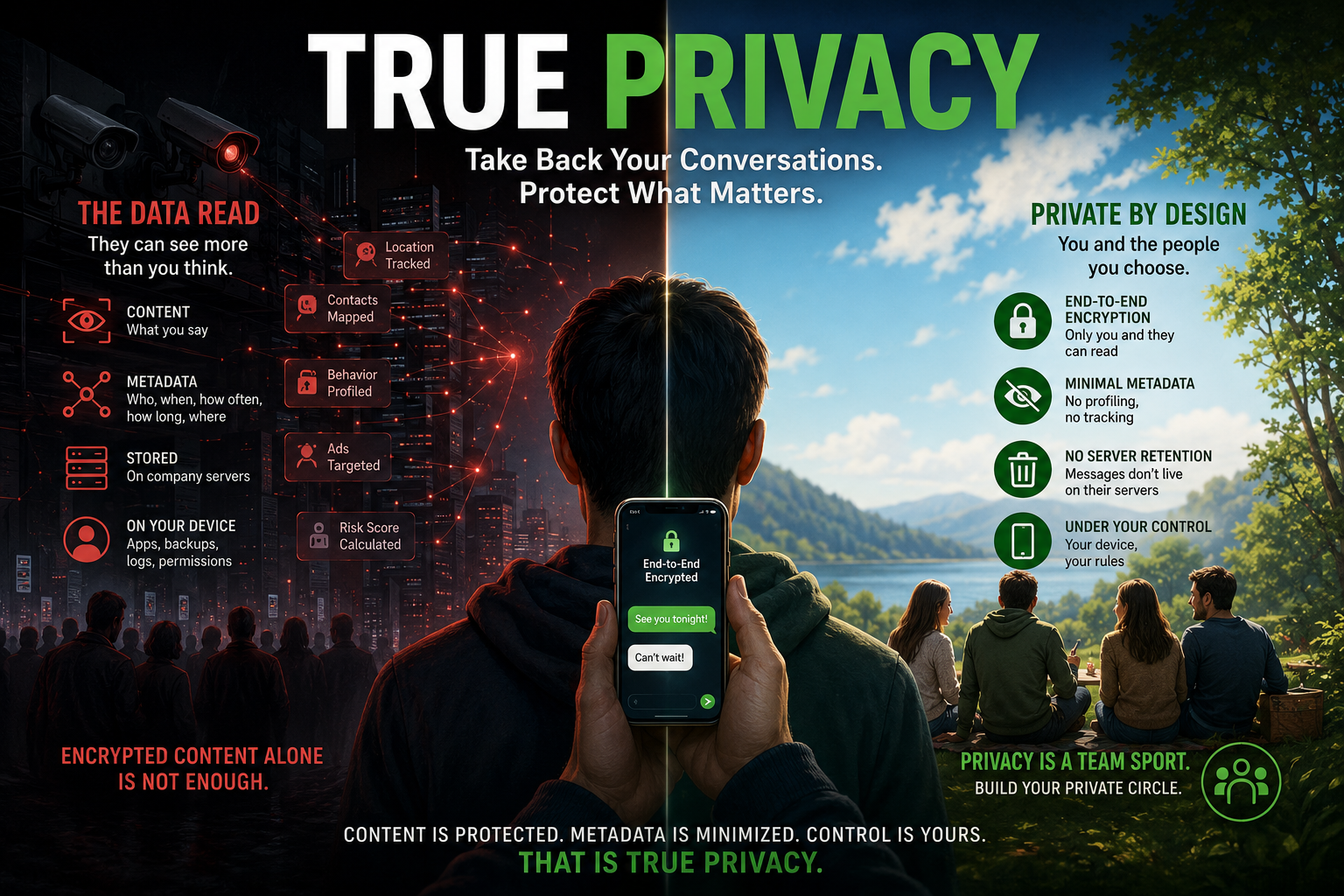
TRUE privacy in communication means that the of what you say is readable only by you and the people you chose to say it to; that the record of who you talked to, when, and how often is minimized or destroyed rather than collected; and that no third party — not the app maker, not the advertiser, not the platform's parent company, not an automated scanner — sits in the middle by design.
Notice that this definition has two halves, and the second half is the one almost everyone misses.
Content vs. metadata: the two things being read
Every message you send has two layers.
The first layer is the content — the words, the photo, the voice note. This is the layer people think of when they think of privacy, and it is the layer the technology industry has largely learned to protect. When an app advertises (E2EE), it is talking about content: the message is scrambled on your device and unscrambled only on the recipient's device, so that even the company running the service cannot read it in between.
The second layer is the — the data about the data. Who you messaged. When. How often. For how long. From what device. From what location. Metadata is the addressing on the envelope rather than the letter inside, and it is spectacularly revealing. The Electronic Frontier Foundation's Kurt Opsahl illustrated it more than a decade ago with examples that have never been improved upon: metadata can show that someone called a suicide-prevention hotline from the Golden Gate Bridge, or an HIV-testing service followed by their doctor followed by their insurer within a single hour1 — without anyone ever hearing a word of the calls.¹
This is not a theoretical concern. In a 2016 Stanford study published in the Proceedings of the National Academy of Sciences, researchers collected telephone metadata from about 800 volunteers and, from patterns alone — no content — were able to infer health conditions, firearm ownership, and other deeply sensitive facts about participants' lives.² And Michael Hayden, the former director of both the NSA and the CIA, put the government's view of it in six words at a 2014 Johns Hopkins debate: "We kill people based on metadata3."³
So here is the first hard truth of TRUE privacy: an app can encrypt every word you send and still read your life. If the company keeps the metadata, the data read continues — it just reads the envelope instead of the letter.
The four places the data read happens
To evaluate any communication tool, you only need to check four locations. The data read happens at one or more of them:
1. In transit. As the message crosses the network. This is the layer that basic (the padlock in your browser, called TLS) protects, and in 2026 nearly everything has it. Transit encryption alone means the coffee-shop Wi-Fi can't read your message — but the company running the service still can, because the message is unscrambled on their servers. When a service says "your data is encrypted" without saying "end-to-end," this is usually all it means.
2. On the server. Where the service stores and processes your messages. Regular email, standard SMS text messages, and social media direct messages all sit readable on servers — which is precisely what allows them to be scanned for advertising signals, "safety," training, or in response to a subpoena. If the provider can read it, the provider will eventually be compelled, breached, or tempted to.
3. On the endpoints — your device and theirs. Even perfect end-to-end encryption only protects the space between two devices. If the sending or receiving phone is compromised, backed up insecurely, or running software that scans messages before they are encrypted, the encryption is bypassed rather than broken. This is the frontier of the privacy fight in 2026, and we will come back to it, because governments have noticed it too.
4. In the backups. The quietest hole in the fence. Your messages can be end-to-end encrypted in flight and then uploaded, readable, to a cloud backup every night. A chat that neither WhatsApp nor Apple can read in transit can be sitting in a Google Drive or iCloud backup that absolutely can be read — and handed over.⁴ A private conversation with unprotected backups is a locked front door with the key under the mat.
TRUE privacy means the data read is closed off at all four locations — on your end and on the other person's end. Which is exactly why this is a conversation you have to have with your family, not just a setting you flip on your own phone.
Part Two: The Data Read in 2026 — Why This Article Is Timely
If you want a one-paragraph answer to a skeptical relative who asks "is this really happening?", here it is, current as of this month.
Five days before this article was published — on July 9, 2026 — the European Parliament reinstated the regulation critics call "Chat Control 1.0," which authorizes platforms to scan private messages of ordinary, unsuspected users for illegal material, warrant-free, through 2028. It passed despite the fact that more members voted against it than for it (314 to 276): under the EU's second-reading rules, blocking it required an absolute majority of 361 votes, and the opposition fell short5.⁵ ⁶ The scanning it authorizes operates on unencrypted services — the everyday ones: Gmail, Facebook and Instagram Messenger, Snapchat, Skype, Xbox, iCloud Mail.⁷ Meanwhile, the permanent version — "Chat Control 2.0," the EU's Child Sexual Abuse Regulation — remains in negotiation, with its fifth negotiating round having collapsed in late June 2026 specifically over the question of suspicionless mass scanning, and talks set to resume in September.⁶ ⁷ The mechanism on the table for reaching encrypted apps is : software on your own phone that inspects your message in the instant before encryption is applied. It doesn't break the lock; it reads over your shoulder while you're writing. More than 500 cryptographers and security researchers have publicly warned that this approach inherently undermines the protection encryption provides, and Signal — the most respected private messenger in the world — has stated it would withdraw from Europe rather than implement it.⁸
I lead with the legislative story because it settles the "is this real" question with a date and a vote count. But for most families, the everyday data read is commercial, not governmental, and it never made the news because it never needed a law — you agreed to it in a terms-of-service dialog:
- The scanning you agreed to. Free email and social messaging platforms have scanned message content and behavior for years — for ad signals, for "safety," and increasingly to feed AI systems. Even after the EU's temporary scanning authorization lapsed in April 2026, Google, Meta, Microsoft and Snap stated they would simply continue scanning private messages7.⁷
- The metadata you can't opt out of. WhatsApp is the instructive case because its content encryption is genuinely excellent — it licensed the same Signal this article recommends. Yet WhatsApp's own privacy policy describes collecting your contacts, usage patterns, device details, connection information, and more, sharing it across the Meta ; and a 2021 ProPublica investigation documented that this metadata is produced to law enforcement9, in some cases in near-real time.⁴ ⁹ Encrypted letter; photocopied envelope.
- The device-level read. Smart TVs that fingerprint what's on the screen, voice assistants that upload "wake word" audio, keyboards that phone home "to improve suggestions," photos that carry hidden GPS coordinates in their EXIF data. The read is not one company; it is an atmosphere.
None of this requires a conspiracy. Every piece of it is a rational business decision by a company whose product is a profile of you. The data read is simply what the default settings do. TRUE privacy is what you get when you change the defaults — deliberately, at all four locations, with the people you actually talk to.
Part Three: The TRUE Privacy Playbook — The Technical Half
You do not need to become a systems administrator. You need one good tool, four settings, and three habits. Here is the whole playbook.
Step 0: Thirty seconds of threat modeling
Before choosing tools, answer three questions — security professionals call this a threat model, and the Electronic Frontier Foundation's Surveillance Self-Defense guide is the gold-standard walkthrough:¹⁰
- What am I protecting? (Family conversations? Health matters? Business dealings? Photos of your kids?)
- Who am I protecting it from? (Advertisers and data brokers? A snooping platform? Criminals after your identity? A government?)
- How bad is it if I fail? (Annoying ads? A leaked medical situation? Real danger?)
For the audience of this article — ordinary families who are tired of being read — the honest answer is usually: protecting everyday life from commercial harvesting, profiling, breaches, and mission creep. That threat model is fully solvable with free tools and about an hour of setup. (If your threat model involves a hostile government or a dangerous individual, you need more than an article — start with the EFF guide above and get individualized help.)
Step 1: Move the conversation to Signal — and understand why it's Signal
Signal is a free, open-source messenger run by a nonprofit foundation. It is the default recommendation of essentially every serious privacy organization, and the reasons map exactly onto the four locations of the data read:
- Content: Everything — messages, calls, video, groups, attachments — is end-to-end encrypted by default with the Signal Protocol, the openly published, independently audited encryption system so well-regarded that WhatsApp, Facebook Messenger, and Google Messages all licensed it.¹¹ In 2023–2024 Signal added post-quantum protections, hardening today's messages against tomorrow's quantum computers.¹¹
- Metadata: This is where Signal separates from everything else. It is engineered not to know things: no record of your contacts, social graph, group memberships, group names, or profile details is stored on its servers, and since 2018 its sealed sender feature hides even the "from" field of a message from Signal's own .¹² The proof is on the public record: when Signal has been subpoenaed, the only data it has been able to produce is the date an account was created and the date it last connected — because that is genuinely all it has. Signal publishes the actual court documents13.¹³
- Server: There is no readable message store to scan, breach, or sell. A nonprofit funded by donations has no advertising business waiting to be fed.
- Endpoints & backups: Signal messages are excluded from Apple and Google cloud backups by design; message history lives encrypted on your device.
Honest limits, because TRUE privacy requires honest accounting: Signal historically registers accounts with a phone number, which links the account to an identity (usernames, added in 2024, now let you connect without revealing your number). Your IP address contacts Signal's servers, so an observer of your network can see that you use Signal, though not with whom. And no messenger can protect a message after it arrives — the recipient can always screenshot. Privacy tools protect you from systems, not from betrayal.
What about the apps your family already uses?
- WhatsApp: Excellent content encryption, heavy metadata collection into the Meta ecosystem, shared with law enforcement on request.⁴ ⁹ If a relative won't leave it, harm-reduce: turn ON end-to-end encrypted backups (it's off by default), turn on disappearing messages, and strip what you can from the profile. But it is a halfway house, not the destination.
- iMessage: Genuinely end-to-end encrypted between Apple devices — but with a historical catch: standard iCloud Backup has included the keys, meaning Apple could access backed-up messages and produce them. Apple's opt-in (introduced December 2022) closes that hole by end-to-end encrypting the backup itself — but you have to turn it on, both ends of the conversation need it, and Apple withdrew the feature entirely in the in early 2025 under government pressure — a live demonstration of why relying on one corporation's policy is not the same as relying on math.¹⁴
- SMS / RCS texting: Plain SMS is a postcard — readable by carriers, stored, and produced routinely. RCS (the newer texting standard) is encrypted between Android users on Google Messages, and a cross-platform encryption standard was announced in 2025 with Apple signaling adoption — but as of this writing you should treat any green-bubble conversation as unprotected until proven otherwise.
- Email: Ordinary email is not private and cannot be made fully private, because the system predates the idea. Treat email as postcards; move anything sensitive to Signal.
Step 2: The four settings that close the remaining holes
Once the family is on Signal (or as a stopgap, on hardened WhatsApp):
- Disappearing messages, on by default. In Signal: Settings → Privacy → Default timer for new chats (one to four weeks is a sane family default). The data read cannot read what no longer exists — and neither can a future phone thief, breach, or subpoena. Retention is risk.
- Lock the account. Signal's Registration Lock (a PIN) prevents someone who hijacks your phone number from taking over your account. Number-hijacking (SIM swapping) is one of the most common real-world attacks on ordinary people.
- Hide the phone number; use a username. Settings → Privacy → Phone Number → set "Who can see my number" to Nobody. Share your Signal username instead.
- Audit the backups. On the phone itself: make sure whatever does get backed up to iCloud/Google is either end-to-end encrypted (Apple ADP where available; WhatsApp E2EE backups if you still use it) or excluded. This one setting, on both ends of a chat, closes the single biggest silent hole in family privacy.
Step 3: The three habits
- Both ends or nothing. A private channel is only as private as its least-careful participant. This is why Part Four of this article exists.
- Strip before you share. Photos carry EXIF metadata — often the exact GPS coordinates of your home. Signal strips it on send; most social platforms strip it on upload but read it first. When in doubt, screenshot the photo and send the screenshot.
- Match the channel to the weight. Some things deserve the most private channel humanity has ever invented, which was also the first: a walk outside, phones left on the kitchen counter. TRUE privacy is not only an app choice. It is the recovered understanding that not every sentence of a human life needs to transit a server at all.
Part Four: How to Actually Talk Your Friends and Family Into It
Here is the part no technical guide covers, and the reason this article was written. The technology is the easy half. The hard half is that privacy is the only home-technology upgrade that requires other people's cooperation — and if you evangelize it badly, you will lose the room for years.
Twenty-five years of moving small-business clients off platforms they were comfortable with onto platforms that actually served them has taught me that people do not adopt better tools because the tools are better. They adopt them when the switch is easy, socially normal, and framed in their own interests. Everything below follows from that.
Rule 1: Never open with fear. Open with the ick they already feel.
Do not start with legislation, encryption, or worst cases. Start with the experience every person at the dinner table has already had:
"You know how you talk about something and then the ad shows up? I finally did something about that for our chats. Took me five minutes. Want me to set yours up?"
Whether that specific folk experience is microphone surveillance or just eerily good profiling is beside the point (the documented reality — that profiles built from your metadata, contacts, and behavior can predict you that well — is arguably creepier). The point is that the feeling of being read is universal. You are not installing a fear in them; you are offering a remedy for one they already have.
Rule 2: Have the "nothing to hide" conversation with questions, not lectures
When someone says "I have nothing to hide," they are not making an argument; they are declining a hassle. Do not rebut — ask:
- "Would you hand me your unlocked phone right now and let me read every chat?" (No one says yes. The follow-up writes itself: "So it's not that there's nothing to hide — it's that it's nobody's business. That's all I'm saying.")
- "You seal envelopes, right? Why? Same thing."
- "Do you want a company's computer reading your texts with your doctor? Your kid? Your accountant?"
And keep one reframe in your pocket for the thoughtful skeptics: privacy is not only self-protection, it is protection of everyone you talk to. When Grandma stays on a harvested platform, it is not only Grandma's metadata being read — it is the social graph, timing, and patterns of every person who messages her. Choosing a private channel is something you do for the people you love, which is precisely the kind of reason families respond to.
Rule 3: Lower the cost of switching to zero
The number-one predictor of whether a family adopts a private messenger is not conviction. It is friction. So remove all of it:
- Do the installation yourself. Physically, on their phone, while you're together at Sunday dinner. Set the disappearing-message timer, the PIN, the notification sound they like. Hand it back working.
- Move one group, not one person. Individuals won't move alone — the value of a messenger is who's on it. Pick the highest-traffic family group chat, get the two most active members on board privately first, then move the group in one announced step: "The cousins' chat is on Signal starting Sunday — I've already set up Mom and Dave."
- Give it a purpose, not an ideology. The successful pitch is almost never "for privacy." It's "this is where we share the kids' photos now" — which lands, because photos of children are the one category even privacy skeptics instinctively want off harvested platforms.
- Don't demand exclusivity. They can keep WhatsApp for the neighborhood group. You are not asking anyone to renounce anything; you are asking them to add one app for the inner circle. Purism loses; coexistence wins.
Rule 4: Be the family's IT department, cheerfully and forever
Every family has one person who set up the Wi-Fi. If you are reading a 5,000-word article about privacy, that person is you. Accept the role formally: you are on call for "how do I send a photo," you never sigh, and you never say "I told you so" when someone's harvested account gets breached. The privacy of your family will be won or lost on your patience, not your arguments.
Rule 5: Expect the timeline of a habit, not a decision
A realistic adoption arc for one extended family is about a season: two weeks for the core group chat, a month for the aunts and uncles, a stubborn holdout or two until a news story or a breach does your persuading for you. That is normal. Every person you move is one more person whose everyday life has a door on it — and one more reason for the next person to walk through.
What to say when they ask "but isn't this what criminals use?"
The honest answer: criminals also use cars, cash, kitchen knives, and sealed envelopes. Encryption is used daily by hospitals, banks, militaries, journalists, and every business that takes a credit card — it is the load-bearing wall of the digital economy. The question is never whether locks exist, because they must; the question is whether your family gets to have one too. And note who already does: the executives of the companies doing the data read are famously careful about their own communications. Take the hint from the people who have seen the machine from the inside. I'm one of them; that's why my family is on Signal.
Part Five: The Honest Limits — What TRUE Privacy Is Not
An article that oversells privacy is doing the data read's work for it, because the first disappointment will discredit the whole project. So, plainly:
- You cannot achieve perfect privacy, and you don't need to. The goal is not invisibility; it is closing the default, automated, industrial-scale read on your ordinary life. That goal is fully achievable this weekend.
- The other end is always the limit. Any recipient can screenshot, forward, or leave their phone unlocked. Encryption protects the pipe, not the people. Choose your confidants the way humans always have.
- Your device is the final . A phone full of apps with contact, microphone, and photo permissions leaks around any messenger. Prune permissions quarterly — it takes ten minutes.
- Existence is visible even when content isn't. A network observer can see that you use Signal, and your phone company always knows where your phone is. TRUE privacy for content and social graph is achievable; anonymity is a different, much heavier project — and for family life, an unnecessary one.
- The rules can change. July 9, 2026 proved that the legal ground under private communication moves — in both directions, since the same vote saw a Parliament majority oppose scanning and an encryption exemption adopted.⁵ ⁶ The lesson is not despair; it is that privacy built on math and habits (encryption, minimal metadata, disappearing messages, analog when it matters) outlasts privacy built on any company's current policy or any legislature's current mood.
The data read is the default. It is not the law of nature. Twenty-five years of building the web has convinced me of exactly one thing about it: defaults are decisions someone else made for you — and every one of them can be remade at your own kitchen table, one phone at a time, starting with the people you love.